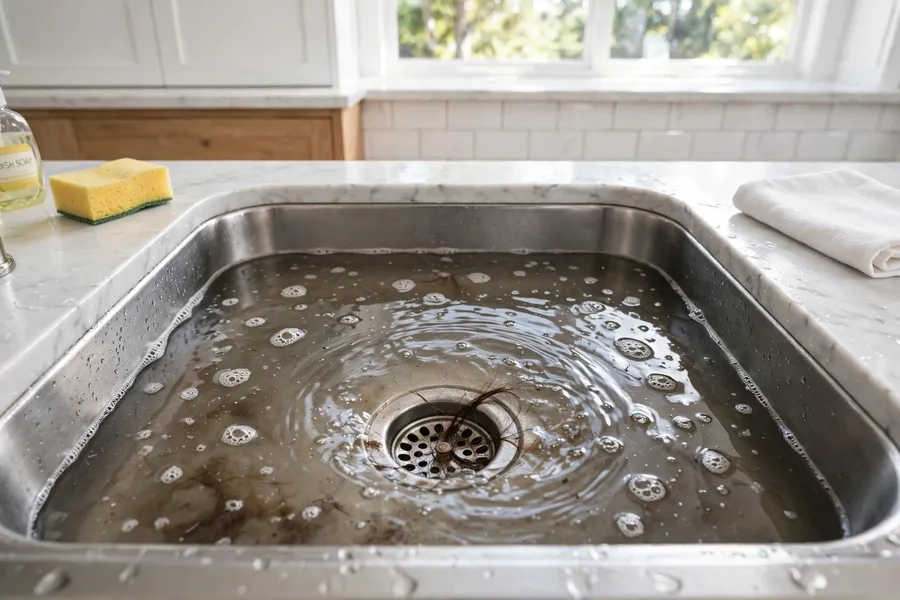
Most drain disasters don't happen out of nowhere. They send warnings for weeks, sometimes months: before the big backup. The trouble is, those warnings are easy to brush off. A sink that drains a little slowly. A faint smell you notice and then forget. A gurgle you blame on "old pipes."
After years of clearing drains across Bothell, we've learned to read these early signals like a weather forecast. Here's what your drains are trying to tell you, and when it's time to stop waiting and call a professional.
1. Water Drains Slowly (and Keeps Getting Slower)
A slow drain is the single most common early warning, and the most ignored. It usually starts subtly: the shower floor holds a little more water than it used to, or the bathroom sink takes an extra ten seconds to empty. What's happening is buildup, hair, soap scum, grease, narrowing the inside of the pipe a millimeter at a time.
Here's the part people miss: slow drains never fix themselves. Buildup only accumulates. That trickle today is a full blockage in a few weeks or months. If more than one drain is slowing down at the same time, the problem may be deeper, in a branch line or the main sewer, and that's firmly professional territory. Our clogged drain repair service handles exactly this, from single fixtures to whole-house slowdowns.
2. Gurgling Sounds From Sinks, Tubs, or Toilets
Gurgling is the sound of air fighting to get past a blockage. When water can't flow freely, it pushes air ahead of it, and that air bubbles back up through your traps, glug-glug-glug. You might hear it in the kitchen sink when the dishwasher runs, or in the tub when you flush the toilet.
Occasional gurgling after heavy use isn't panic-worthy. But regular gurgling, especially from multiple fixtures, means air is trapped by a developing clog somewhere downstream. It's one of the most reliable predictors of a coming backup, and it's worth a professional look before it graduates to something messier.
3. Unpleasant Odors Coming From Drains
A healthy drain doesn't smell like anything. So when you catch a whiff of rotten eggs, sewage, or mustiness from a sink or floor drain, something is off. Common causes include rotting food trapped in the line, a dried-out P-trap letting sewer gas through, or, more seriously, a partial sewer line blockage pushing gases back into the house.
Try this first: pour water into rarely used drains (floor drains, guest bathroom sinks) to refill dried traps. If the smell persists after a day or two, the cause is buildup or a blockage deeper in, and it needs professional cleaning. Persistent sewer smells should never be ignored, they're both unpleasant and a sign of a real plumbing problem.
4. Water Backing Up in Unexpected Places
This is the warning sign that gets everyone's attention: you run the washing machine and water appears in the shower. You flush the toilet and the bathtub gurgles up. You run the kitchen sink and the dishwasher fills with dirty water.
When water shows up where it shouldn't, it means a shared drain line is blocked and water is taking the path of least resistance, back up through another fixture. This is almost always a main-line or branch-line issue, not a single clogged fixture. Don't keep using water "to see if it clears." It won't, and you risk an overflow. This is the moment to call for emergency drain cleaning, especially if sewage is involved.
5. Recurring Clogs in the Same Drain
Cleared the same bathroom sink three times this year? The clog keeps coming back because the underlying cause was never fully removed. Store-bought drain cleaners and hand augers often punch a small hole through the blockage, enough for water to pass temporarily, while the bulk of the buildup stays glued to the pipe walls.
Recurring clogs are a textbook case for professional equipment. A motorized auger or hydro jetter doesn't just poke through the clog; it removes the full accumulation from the pipe walls. If you've cleared the same drain more than twice, stop repeating the cycle and get it properly cleaned once.
6. Multiple Fixtures Acting Up at Once
One slow sink is a fixture problem. The kitchen sink, the guest bathroom, and the laundry drain all acting up? That's a system problem. When several fixtures misbehave simultaneously, the blockage is almost certainly in a shared line, a branch drain or the main sewer line serving the house.
Main-line blockages are the ones that lead to sewage backups, and they're also the ones homeowners can't reach with any DIY tool. Tree roots, collapsed sections, heavy grease, or settled sediment in the main line all need professional diagnosis, usually starting with a camera inspection so you're fixing the actual cause, not guessing.
7. Fruit Flies or Drain Flies Hanging Around
Those tiny flies hovering around your kitchen or bathroom sink aren't coming from the fruit bowl, they're breeding in the slimy buildup coating the inside of your drain. Drain flies lay eggs in that organic film, and their presence means there's a substantial layer of gunk in there.
Bleach and boiling water might kill the flies you see, but the breeding ground remains. A thorough professional cleaning removes the buildup they're living in, which solves both the fly problem and the slow drainage that's usually developing alongside it.
When to Call vs. When to Wait
Not every symptom needs a same-day call. Here's a simple rule of thumb:
- Call now: sewage backup, water backing up into other fixtures, foul sewage smells throughout the house, or a completely blocked drain you depend on.
- Schedule soon: persistent slow drainage, recurring clogs, regular gurgling, or multiple fixtures slowing down together.
- Monitor: a single slightly slow drain with no other symptoms, but don't ignore it for months.
The pattern across all seven signs is the same: drains warn you before they fail. Homeowners who act on the early signs get a quick, straightforward cleaning. Those who wait get an emergency. If any of these sound familiar, we'd rather hear from you now than at midnight.
Frequently Asked Questions
How do I know if slow drains are serious?
A single slow drain is usually a minor local clog. Multiple slow drains, gurgling, or bad smells alongside the slowness point to a deeper line problem that needs professional attention.
Can I just use chemical drain cleaner for these warning signs?
Chemical cleaners sometimes clear minor surface clogs, but they can't remove heavy buildup, roots, or main-line blockages, and harsh chemicals can damage older pipes. For recurring or multi-fixture symptoms, professional cleaning is safer and more effective.
How fast can a slow drain turn into a backup?
It varies, weeks to months for gradual buildup, but a main-line blockage can escalate in days once symptoms like gurgling and cross-fixture backups appear. Early signs deserve prompt attention, not a wait-and-see approach.
Dealing With One of These Warning Signs?
Don't wait for a backup. Call Bothell Drain Pros, same-day service across Bothell and surrounding areas.
Call (425) 307-0127 Now