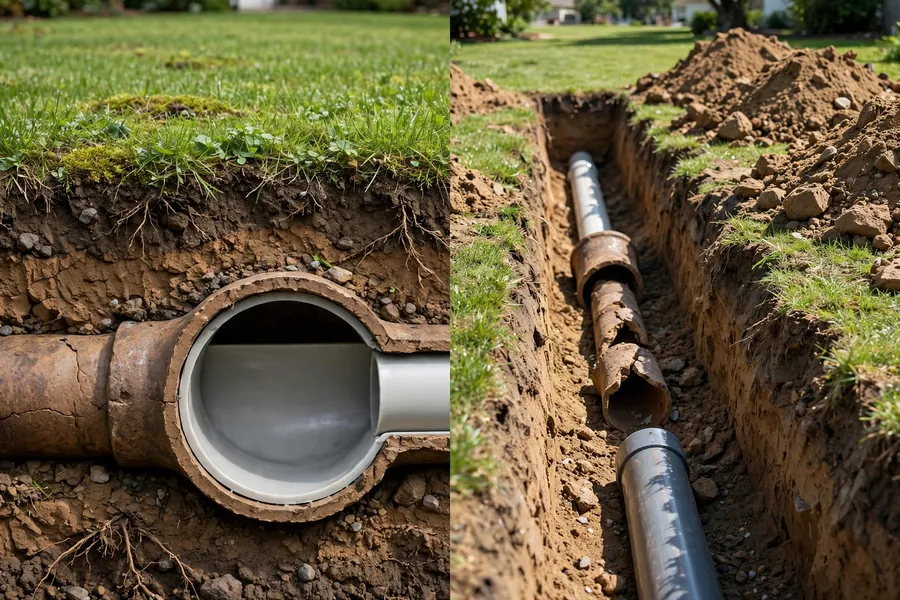
The camera inspection just delivered news no homeowner wants: your main sewer line is damaged. Cracked clay, root intrusion, a section starting to fail. Now comes the next question, and it is an important one: should the line be relined, or replaced?
Both are legitimate repairs, and both have their place. The right choice depends on what the camera actually showed inside your pipe. Here is how professionals think through the decision, so you can follow along with confidence.
What Sewer Relining Actually Is
Relining, usually called cured-in-place pipe, creates a brand-new pipe inside the old one. A flexible liner soaked in resin is inserted into the damaged line, pressed against the old pipe walls, and cured until hard. The result is a smooth, jointless new pipe that uses the old line as its mold.
The defining advantage is what does not happen: no trench across your yard, driveway, or landscaping. The work happens through small access points, and the surface above stays untouched.
What Full Replacement Involves
Replacement is the traditional approach: excavate down to the damaged section, remove the failed pipe, and install new pipe in its place. It is straightforward and definitive, and in certain situations it is the only option that works. The tradeoff is disruption: digging equipment, disturbed soil, and restoring whatever sat above the line afterward.
When Relining Is the Right Call
Relining shines when the existing pipe is damaged but still sound enough in structure to host a liner. Typical candidates include pipes with cracks or fractures, joints invaded by roots, and lines roughened by age and scale. The camera inspection is what confirms this, because the pipe needs to hold its basic shape for a liner to cure properly inside it.
When Replacement Is the Honest Answer
Some damage is beyond what a liner can fix. A fully collapsed section has no shape left to line. A belly, a low spot where the pipe sags and holds standing water, will still hold water inside a liner. Severely offset joints or a line with the wrong slope need their geometry corrected, and only excavation can do that. A reputable technician will tell you this plainly instead of selling a liner that cannot work.
Why the Camera Inspection Always Comes First
Notice that every recommendation above starts with what the camera showed. That is not a coincidence. Without seeing inside the line, choosing between relining and replacement is guesswork, and guesswork is how homeowners pay for the wrong repair. Our sewer camera inspection gives you the actual footage plus a straight explanation of what it means, and our sewer line repair service covers both trenchless and traditional methods, so the recommendation fits your pipe, not the other way around.
Questions Worth Asking Before You Decide
Ask to see the camera footage yourself and have the problem spots pointed out. Ask whether the pipe's shape is intact enough for a liner, and what happens if it is not. And ask what the plan is if the chosen method reveals surprises mid-job. Clear answers to these three questions separate a professional diagnosis from a sales pitch.
Frequently Asked Questions
How do I know if my pipe can be relined?
Only a camera inspection can answer this. The pipe needs to hold its basic shape for a liner to cure properly inside it, so collapsed sections, severe bellies, and badly offset joints rule relining out.
Does relining last as long as a new pipe?
A properly installed liner is designed as a long-term repair, creating a smooth, jointless pipe within the old one. Its lifespan depends on the host pipe's condition and what caused the damage, which is why the camera diagnosis matters so much.
Will relining fix a pipe full of tree roots?
Roots have to be cut out first, and if the pipe is still structurally sound afterward, relining can work well. The resulting jointless surface also gives roots far fewer entry points in the future.
Dealing With One of These Warning Signs?
Don't wait for a backup. Call Bothell Drain Pros, same-day service across Bothell and surrounding areas.
Call (425) 307-0127 Now